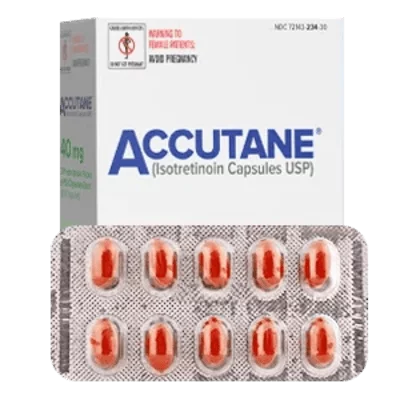
Accutane is a prescription acne medicine in the systemic retinoid class. It is intended for people whose severe or persistent acne has not responded adequately to standard treatments. Its active ingredient, isotretinoin, reduces sebaceous gland activity and the oil production that drives inflammatory acne.
Description
Accutane is an oral prescription retinoid containing isotretinoin capsules for severe, nodular, or treatment-resistant acne. Isotretinoin is a vitamin A derivative known as a systemic retinoid. The dose is stated on the pack—follow the leaflet.
Composition
Accutane contains isotretinoin, a vitamin A derivative known as a systemic retinoid. The dose is stated on the pack—follow the leaflet. It is prescribed as a planned treatment course rather than taken occasionally for individual spots.
Isotretinoin targets several acne mechanisms at once: excessive sebum, blocked pores, growth conditions for Cutibacterium acnes, and inflammation. This broad action explains why it is reserved for persistent, scarring, nodular, or psychologically distressing acne.
Accutane capsules should be swallowed whole. Do not open, crush, or chew them, because the capsule contents can irritate skin and mucous membranes if they escape.
The treatment has substantial effects, and it also has important limitations. Dryness is expected, laboratory monitoring is part of the course, and pregnancy prevention is mandatory for anyone who can become pregnant. The EMA describes isotretinoin as a medicine requiring strict pregnancy-prevention measures because exposure during pregnancy can cause severe fetal harm [1].
Dosage and usage
Accutane is taken by mouth, usually once or twice daily with food. Dietary fat improves isotretinoin absorption, so taking each dose with a substantial meal helps keep exposure more consistent.
Prescribers commonly begin with a dose stated on the pack—follow the leaflet—then adjust according to acne severity, dryness, laboratory results, and tolerance. The dose is stated on the pack—follow the leaflet. The capsule strength can support lower starting doses or carefully tailored dose adjustments.
A typical course lasts four to six months. Dermatologists also consider cumulative dose, meaning the total amount taken throughout the course, rather than judging progress only by the first few weeks. The American Academy of Dermatology guideline supports oral isotretinoin for severe acne and acne that has failed standard therapies [3].
Common administration mistakes include:
Taking capsules without food, which may reduce absorption.
Stopping after an early flare without contacting the prescriber.
Sharing capsules with another person who has acne.
Using vitamin A supplements at the same time.
Donating blood during treatment or for one month after the final dose.
Waxing, dermabrasion, or aggressive laser resurfacing while skin is fragile.
Assuming one missed capsule requires doubling the next dose.
If a dose is missed, take it when remembered unless the next scheduled dose is close. Do not take two doses together.
Keep a simple note of the date each capsule is taken. During a months-long course, this is more useful than relying on memory, especially when the dose changes after a follow-up visit.
How it works
Accutane works mainly by shrinking and suppressing sebaceous glands. These glands produce sebum, the oily material that can block follicles and contribute to whiteheads, blackheads, painful papules, pustules, and nodules. Less sebum changes the follicular environment. Acne-associated bacteria have less oil to use, pore blockage falls, and inflammatory lesions gradually become less frequent.
Accutane does not act like an antibiotic. It does not kill bacteria directly, and it does not work like a topical retinoid applied to the skin.
A full course often produces a prolonged reduction in acne activity. Relapse can still occur, especially after lower cumulative exposure, severe baseline disease, hormonal acne patterns, or treatment interruptions.
The World Health Organization includes isotretinoin among medicines used for severe acne management where specialist assessment and monitoring are available [2].
Indications
It is used for people whose acne has not responded adequately to standard topical or oral treatments.
Comparison
Accutane is generally considered after standard acne treatment has been insufficient, poorly tolerated, or unable to prevent scarring. The best alternative depends on lesion type, acne severity, pregnancy potential, skin sensitivity, and prior treatment response.
Treatment approach
Main action
Usual place in acne care
Isotretinoin capsules
Strongly suppresses sebum and normalises follicular shedding
Severe, nodular, scarring, or resistant acne
Oral tetracycline antibiotic
Reduces inflammatory bacterial activity
Moderate-to-severe inflammatory acne for limited courses
Topical retinoid with benzoyl peroxide
Unblocks pores and reduces surface inflammation
Mild-to-moderate acne or maintenance treatment
Topical retinoids can help prevent new comedones, though they do not produce the same sebaceous gland suppression as isotretinoin. Oral antibiotics can reduce inflammatory lesions, yet they are not intended as indefinite treatment because antimicrobial resistance is a concern.
Contraindications
Accutane is not for you if you are pregnant, may be pregnant without reliable pregnancy prevention, are breastfeeding, or have an allergy to isotretinoin or a capsule component. Isotretinoin is a potent teratogen. Pregnancy must be excluded before treatment, reliably prevented throughout treatment, and prevented for at least one month after the final capsule.
Accutane is also unsuitable or requires specialist consideration in the following situations:
Current treatment with tetracycline antibiotics, including doxycycline or minocycline.
Use of vitamin A supplements or other retinoid medicines.
A history of serious depression, self-harm, psychosis, or major mood instability that requires close monitoring.
Combining isotretinoin with tetracyclines can raise the risk of intracranial hypertension, sometimes called pseudotumour cerebri. Warning signs include severe headache, nausea, vomiting, and visual changes. The EMA’s safety review also calls for attention to psychiatric symptoms during isotretinoin treatment [4].
Pregnancy testing and reliable contraception are not optional details. They are core safety requirements. A pregnancy occurring during treatment or within one month after stopping requires urgent specialist medical contact.
When this is not for you
Do not use Accutane if you are pregnant, could become pregnant without reliable contraception, are breastfeeding, or have ever had an allergic reaction to isotretinoin or one of the capsule ingredients. Tell your prescriber if you take doxycycline, minocycline, vitamin A supplements, or another retinoid, or if you have liver disease, very high blood fats, raised pressure in the skull, or a significant history of mental-health problems.
Side effects
Dryness is the defining Accutane side effect. Chapped lips occur in most users, while dry facial skin, peeling around the nose, dry eyes, nosebleeds, and increased sensitivity to sunlight are also common. These effects reflect reduced sebum production and tend to increase with dose.
Some people develop muscle or joint aches, especially after intense exercise. Headache, tiredness, temporary hair shedding, and mild changes in night vision can occur. Contact lens wear can become uncomfortable because tear-film production may fall.
For recurring nosebleeds, a tiny amount of plain moisturising ointment just inside the nostrils can reduce cracking. Persistent or heavy bleeding needs prompt medical assessment.
Serious reactions are uncommon but require immediate attention. These include severe or persistent headache with nausea or visual disturbance, marked mood changes, suicidal thoughts, severe abdominal pain, bloody diarrhoea, yellowing of the eyes or skin, or a widespread blistering rash.
Liver enzymes and blood lipids can rise during treatment. Blood tests before treatment and at intervals during the course allow the prescriber to identify clinically significant changes early. Alcohol can place additional strain on the liver and may worsen triglyceride elevation, so limiting or avoiding it is sensible during therapy.
Common mistakes
The most frequent mistake is expecting clear skin within days. Isotretinoin changes sebaceous gland activity gradually, and inflammatory lesions may temporarily increase early in treatment.
Another common error is adding multiple drying acne products. Strong exfoliants, retinoid creams, benzoyl peroxide, harsh cleansers, and alcohol-heavy toners can turn manageable dryness into burning, fissuring, and dermatitis. A simpler routine is usually better during a course.
Some patients stop moisturising because their skin feels oily at baseline. That approach backfires once Accutane reduces sebum. Barrier support helps people stay comfortable enough to continue treatment.
Avoid waxing during treatment and for several months after it ends. Isotretinoin can leave skin more vulnerable to lifting, tearing, prolonged redness, and pigment changes after hair removal.
Skipping monitoring appointments is also risky. Lipid and liver changes may not cause obvious symptoms at first. The course should be adjusted using both clinical response and laboratory results.
What doctors say
In dermatology practice, Accutane is usually discussed when acne is leaving scars, causing deep painful nodules, or returning despite properly used standard therapy. Doctors often prepare patients for two realities: the first month can look worse before it looks better, and dryness needs active management rather than endurance.
Mood symptoms need a balanced approach. Acne itself can affect confidence and mental health, while a possible relationship between isotretinoin and psychiatric symptoms remains difficult to separate in individual patients. Any new depression, agitation, unusual irritability, or suicidal thinking deserves prompt assessment.
Frequently asked questions
How quickly does Accutane improve acne?
Early improvement often becomes noticeable after six to eight weeks, while a full course commonly lasts four to six months. Some people develop a temporary flare during the first month as existing blocked follicles surface. The American Academy of Dermatology’s 2024 acne guideline supports isotretinoin when acne is severe or resistant to standard care . Continuing treatment as prescribed is more meaningful than judging the final response in the first few weeks.
Can Accutane be taken with food?
Yes. Accutane capsules are generally taken with food because food, especially a meal containing some fat, improves absorption of isotretinoin. Taking it at a similar time each day can make the routine easier to maintain. The 2018 EMA product information for isotretinoin-containing medicines describes oral administration with food as part of standard use. Swallow the capsule whole with water.
Can I use skincare products during Accutane treatment?
A basic routine is usually best: gentle cleanser, non-comedogenic moisturiser, lip balm, and broad-spectrum sunscreen. Avoid abrasive facial scrubs, waxing, strong chemical peels, and multiple active acne products unless the prescriber has included them in the plan. Skin becomes more fragile because sebum production falls. The 2024 American Academy of Dermatology guidance supports combining treatment decisions with tolerability and skin-care measures .
Why are pregnancy precautions so strict with Accutane?
Isotretinoin can cause severe congenital malformations and pregnancy loss when exposure occurs during pregnancy. Pregnancy must be excluded before treatment, avoided throughout the course, and avoided for one month after the last dose. The EMA’s 2018 safety measures require a pregnancy-prevention programme for isotretinoin because fetal risk is so serious . Breastfeeding is also incompatible with treatment.
Can Accutane affect mood?
Mood changes, depression, anxiety, aggression, and suicidal thoughts have been reported during isotretinoin treatment, although acne itself can also affect mental wellbeing. Any clear mood change, loss of interest, unusual agitation, or suicidal thinking requires urgent medical attention. The EMA reviewed psychiatric reports in 2018 and recommends that patients and families remain alert to behavioural changes . Mentioning a past mental-health condition before treatment allows closer follow-up.
Why are liver tests and lipid tests needed?
Isotretinoin can increase triglycerides, cholesterol fractions, and liver enzymes in some people. These changes may be detectable on blood tests before symptoms appear, allowing dose adjustment or treatment interruption when needed. The FDA's 2008 prescribing information for isotretinoin describes monitoring of fasting lipids and liver function during therapy [5]. Alcohol can worsen triglyceride and liver-related concerns.
Do you offer anonymous delivery?
Your order will be securely packed and shipped within 24 hours. This is exactly what your package will look like (images of an actual item sent). It has the size and look of a regular private letter (9.4x4.3x0.3 in. or 24x11x0.7 cm) and its contents cannot be seen.
Accutane: Reviews and Experiences
3.9
Based on 4 reviews
M
Mariam, 24
Dubai
Using for five months
Verified
Rating: 4.5 out of 5
My lower-face acne became more inflamed during the first three weeks, and I nearly gave up. By the second month, the deep painful spots were much less frequent. The lip dryness was constant, so I kept balm in every bag.
14 Aug 2026
O
Omar, 29
Abu Dhabi
Using for four months
Verified
Rating: 4.5 out of 5
I had tried creams and antibiotics for years. Accutane was the first treatment that reduced the oily shine as well as the cysts. I noticed dry eyes during long workdays and switched from contact lenses to glasses more often.
24 Aug 2026
S
Sara, 21
Sharjah
Using for three months
Verified
Rating: 3.5 out of 5
The acne on my cheeks improved, but I underestimated sun sensitivity and got irritated after spending an afternoon outdoors. Sunscreen and a gentler cleanser made a bigger difference than I expected.
2 Sep 2026
K
Khalid, 31
Al Ain
Using for six months
Verified
Rating: 3 out of 5
The result was only partly satisfactory for my back acne, and the muscle aches after football were frustrating. My prescriber adjusted the plan after blood tests, and the aches became easier to manage.
11 Sep 2026
Sources
European Medicines Agency (2018). Isotretinoin-containing medicinal products: pregnancy prevention programme and warnings on psychiatric disorders.
World Health Organization (2023). WHO Model List of Essential Medicines.
American Academy of Dermatology (2024). Guidelines of care for the management of acne vulgaris.
European Medicines Agency (2018). Measures to avoid pregnancy exposure with retinoids and warnings on possible neuropsychiatric disorders.
U.S. Food and Drug Administration (2008). Accutane (isotretinoin capsules) prescribing information.