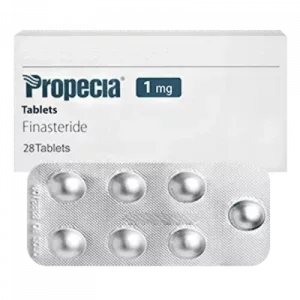
Description
Finasteride is an oral medicine in the 5-alpha-reductase inhibitor class. It is used in adult men for androgenetic alopecia, also called male-pattern hair loss, and for urinary symptoms linked to benign prostatic hyperplasia, depending on the prescribed strength and indication. By blocking conversion of testosterone to dihydrotestosterone, or DHT, it reduces the hormonal signal that contributes to follicle miniaturisation and prostate enlargement. [1]
DHT is a potent androgen. In the scalp, genetically sensitive follicles can gradually produce thinner, shorter hairs. In the prostate, DHT contributes to tissue growth that may narrow the urinary channel.
Finasteride pills are taken orally. The medicine acts on hormone metabolism rather than directly stimulating hair follicles or relaxing prostate muscle.
Composition
By blocking conversion of testosterone to dihydrotestosterone, or DHT, it reduces the hormonal signal that contributes to follicle miniaturisation and prostate enlargement. [1]
DHT is a potent androgen. In the scalp, genetically sensitive follicles can gradually produce thinner, shorter hairs. In the prostate, DHT contributes to tissue growth that may narrow the urinary channel.
Finasteride pills are taken orally. The medicine acts on hormone metabolism rather than directly stimulating hair follicles or relaxing prostate muscle.
A useful routine is to take Finasteride at the same time each day. Linking it to an established habit, such as breakfast or brushing teeth, reduces missed doses without requiring a complicated schedule.
Dosage and usage
Finasteride pills are swallowed whole with water. They may be taken with or without food, and the prescribed daily schedule should be followed consistently.
- Take the prescribed dose once daily unless a clinician has given a different regimen.
- Swallow the pill rather than crushing it.
- If a dose is missed, take the next scheduled dose at the usual time. Do not take an extra pill to compensate.
- Continue treatment for the intended indication. Stopping Finasteride can allow DHT-driven hair loss or prostate growth to resume.
- Keep follow-up appointments when Finasteride is used for urinary symptoms, prostate enlargement, or PSA monitoring.
The treatment goal differs by indication. Men using it for hair loss often assess progress with photos taken under the same lighting every few months. Men using it for prostate symptoms should focus on urinary flow, nighttime urination, urgency, and the feeling of incomplete emptying.
Avoid judging hair results from a single mirror check. Hair length, lighting, humidity, and styling can make the scalp look very different from one day to another.
Hair treatment takes patience. A follicle follows a slow growth cycle, so visible changes develop over months rather than days. With prostate symptoms, the benefit also builds gradually because the medicine changes prostate biology rather than providing immediate urinary relief.
How it works
Finasteride selectively inhibits type II 5-alpha-reductase, the enzyme that changes testosterone into DHT. Blood and tissue DHT levels fall, while testosterone is usually affected far less. This explains why Finasteride can slow further hair thinning in suitable men and can reduce prostate volume over time. [2]
The medicine does not create new follicles where follicles are no longer viable. Its main role in hair loss is maintaining existing susceptible follicles and improving density in some users.
Early changes may be subtle: less hair collecting in the shower drain or a slower widening of the parting can appear before a person notices thicker-looking coverage in photographs.
Indications
It is used in adult men for androgenetic alopecia, also called male-pattern hair loss, and for urinary symptoms linked to benign prostatic hyperplasia, depending on the prescribed strength and indication.
Comparison
Dutasteride suppresses DHT more broadly than Finasteride, which may be useful in selected prostate cases. It also has a longer persistence in the body, so unwanted effects may take longer to settle after discontinuation. Topical minoxidil does not alter androgen metabolism and may be paired with a DHT-lowering approach for hair loss when a clinician considers the combination appropriate.
For urinary symptoms caused by an enlarged prostate, alpha-blockers are another medical category. They relax smooth muscle around the prostate and bladder neck, so they can improve flow more quickly than Finasteride. They do not reduce prostate size in the same way.
Contraindications
Finasteride is not for you if you have had a serious allergic reaction to finasteride or a component of the pills.
It is intended for adult men. Women who are pregnant or could become pregnant should not handle crushed or broken Finasteride pills because absorption of the active substance may affect development of a male fetus.
- You have urinary retention, recurrent urinary infections, blood in the urine, or kidney impairment from obstruction.
- You are undergoing PSA-based prostate assessment.
When this is not for you
Women who are pregnant or could become pregnant should not handle crushed or broken Finasteride pills because absorption of the active substance may affect development of a male fetus. Intact film-coated pills are designed to limit contact with the active substance during normal handling.
Extra caution is needed in the following situations:
- You have depression, a history of suicidal thoughts, or a substantial mood disorder.
- You are being assessed for fertility problems or are trying to conceive.
- You have a breast lump, nipple discharge, or unexplained breast enlargement.
Side effects
Most men tolerate Finasteride without severe problems, yet sexual and mood-related effects deserve an honest discussion. FDA prescribing information describes possible reduced libido, erectile dysfunction, ejaculation changes, and reduced semen volume. These effects occurred in a minority of trial participants, though they can be distressing when they occur. Patients should receive clear counselling before treatment. Follow-up can help distinguish persistent symptoms from temporary changes. [1]
Reported sexual effects may appear early in treatment. Some men find they improve while treatment continues, while others prefer to discuss a different approach with their prescriber. Fertility concerns should also be raised before starting, since Finasteride can affect semen parameters in some men.
Potential effects include:
- lower sexual desire;
- difficulty achieving or maintaining an erection;
- reduced ejaculate volume;
- breast tenderness or breast enlargement;
- rash, itching, or swelling suggesting an allergic reaction;
- low mood, depression, or suicidal thoughts.
Breast lumps, nipple discharge, marked breast pain, facial swelling, difficulty breathing, or suicidal thoughts require prompt medical assessment. A new mood change should not be dismissed as ordinary stress when it appears after starting a hormone-active medicine.
Tell the clinician arranging blood tests that you use Finasteride. The medicine can lower prostate-specific antigen, or PSA, which affects how prostate screening results are interpreted.
Common mistakes
Finasteride works best when expectations match its pharmacology. These are the patterns that most often lead to disappointment or avoidable anxiety.
- Stopping after a few weeks: hair follicles and prostate tissue change slowly, so early treatment rarely reflects the eventual response.
- Doubling a missed dose: extra pills do not restore consistency and may increase unwanted effects.
- Expecting immediate hair regrowth: Finasteride reduces DHT exposure; it does not instantly change the hair-growth cycle.
- Ignoring sexual symptoms: reduced libido or erection changes should be documented and discussed rather than silently tolerated.
- Forgetting PSA interpretation: a PSA result without Finasteride context can be misleading.
- Changing several hair treatments at once: this makes it difficult to identify what caused shedding, irritation, or improvement.
- Using irregular photo comparisons: different lighting and hair length can create a false impression of sudden loss or regrowth.
What doctors say
In clinical practice, doctors usually set expectations before Finasteride is started. It is a maintenance treatment, not a rapid cosmetic fix. For hair loss, the first objective is often slowing progression; visible regrowth is a possible added benefit rather than a promise.
For benign prostatic hyperplasia, clinicians look at prostate size, urinary symptom burden, PSA results, and the risk of progression. The American Urological Association includes 5-alpha-reductase inhibitors among established medical options for men with prostate enlargement and lower urinary tract symptoms. NICE also recognises 5-alpha-reductase inhibitors as an option for selected men with benign prostatic hyperplasia. [3]
A physician will also distinguish a receding hairline from diffuse shedding caused by iron deficiency, thyroid disease, severe illness, restrictive dieting, or scalp inflammation. Finasteride targets androgen-sensitive follicle changes, so it will not correct every cause of hair loss.
Mood history matters. A man with prior depression can still be assessed for Finasteride, yet he should have a clear plan for recognising new low mood, anxiety, or intrusive thoughts.